Essential eight / Convictions
Test what
you
believe.
Hold something real.
Stay open to the evidence.

For young people of the screen-born generation.
Adapted from Brendan O’Keefe’s onetoeight guide.
V.1.0.0
Some beliefs
sound good in calm weather.
An imagined scene. The details may vary.
You have a list of values. Kindness. Honesty. Courage. You mean them.
Then a friend betrays you. A plan collapses. Someone you trusted behaves badly. You make a choice that costs you more than expected.
The words remain on the list, but they now have weight. Are you still willing to be honest when lying would protect you? Can you be kind without becoming a doormat? What does courage look like when nobody applauds?
You may also discover that a belief you inherited no longer makes sense to you. A question you avoided becomes impossible to ignore.
Essential Eight is about convictions: the ideas, values and commitments that help you decide how to live. The Universal version does not tell you which worldview to choose. It asks you to examine what you believe, test it against reality and remain willing to learn.
A conviction is stronger than a mood and more personal than a slogan. It may come from family, culture, religion, philosophy, science, experience or a combination. It should not become immune to questions simply because it is familiar.
Testing does not mean trying to destroy every belief. It means finding out what you actually hold, what evidence supports it, where its limits are and how it affects other people.
The short version
This chapter is about working out which of your beliefs would actually carry weight.
- Some beliefs sound good in calm weather. Pressure reveals the structure.
- Decorative beliefs look fine until they cost you something. Load-bearing ones shape what you do.
- Knowing about something is not the same as living it. A theory is not yet a way of life.
- Examining a belief honestly is not the same as abandoning it. “I do not know yet” can be an honest and responsible answer.
What you’ll do: take one conviction through a week of honest questions, and write down what changed.
Would it carry
any weight?
Some beliefs are part of the decoration of a life. They sound attractive in a profile or conversation, but they have not yet guided a difficult choice.
Other convictions are load-bearing. They shape what you do when the easy option conflicts with what you say matters. They are not necessarily loud or certain. They are simply connected to action.
Look for the evidence in your life
If you say you value people, how do you behave when someone is inconvenient? If you value truth, what happens when honesty costs you status? If you value freedom, do you respect another person’s freedom when they disagree with you?
This is not an invitation to judge yourself theatrically. Nobody lives perfectly. The gap between a value and an action is information. It shows where practice, repair or a more honest belief may be needed.
Do not confuse certainty with strength
A person can be completely certain and completely wrong. A person can have doubts and still act with integrity. Strong convictions can include humility: “This is what I currently believe, this is why, and here is what would make me reconsider.”
A useful test
Write one conviction in a sentence. Then add: “I believe this because…” and “I would need to examine…” If the second sentence is impossible, you may be protecting an identity rather than examining an idea.
A conviction should help you see more clearly, not excuse cruelty, silence questions or make you incapable of hearing another person.
Pressure reveals
the structure.
Testing is not always a dramatic crisis. Often it is a long season of small disappointments and uncomfortable questions.
Suffering.
Pain may challenge what you think is fair, meaningful or possible. You do not need to turn suffering into a lesson before you are ready.
Doubt.
A question may not disappear because you avoid it. Bring it to evidence, reflection and people who can discuss it without panic.
Success.
Comfort can make values feel unnecessary. Notice what happens when you have more status, money, attention or choice.
Hypocrisy.
People who represent a belief may fail to live by it. Their failure matters, but it does not automatically settle whether the underlying idea is true.
Silence.
Reflection may not produce an immediate answer. You can keep asking, pause the question or seek support without pretending certainty.
No forced meaning
You do not have to call pain good, treat doubt as weakness or stay in a community that harms you. Testing a conviction must not become an excuse to accept abuse.
When life breaks
the bargain.
Many beliefs quietly contain a bargain: if I do the right things, life will reward me; if I trust people, they will not hurt me; if I work hard, the outcome will be fair.
Sometimes those expectations are reasonable. None is guaranteed.
A tested conviction may become more modest and more durable. Kindness can matter even when it is not returned. Honesty can matter even when it costs you. A person can be worth caring about without being safe to trust with everything.
Let disappointment change the right thing
When a belief is challenged, ask what exactly failed. Was the principle wrong, or was a prediction too confident? Did a person betray a value, or did the value itself cause the harm? Is the answer to leave, repair, revise, grieve or seek another perspective?
You are allowed to change your mind. Changing a belief after examining it is not weakness. Refusing to change because you once announced it publicly is not strength.
Make room for grief
Some questions do not have quick answers. You can sit with grief, anger and uncertainty while still making the next safe choice. You do not need a polished explanation for a painful event.
Convictions become more honest when they include the possibility of repair. What would you do after causing harm? What would you need from someone who harmed you? What boundary would allow trust to grow again?
A theory is not
yet a way of life.
You can know about courage without acting courageously. You can explain justice without defending someone who is unpopular. You can read about friendship without showing up when it is inconvenient.
Information matters. It gives you language, history and alternatives. Experience tests whether an idea can guide a real decision with real consequences.
Use the conviction in miniature
If you value fairness, practise it in a small disagreement. If you value curiosity, ask a question before defending your view. If you value care, do one useful thing without needing credit. Small actions do not prove a worldview, but they reveal how it is becoming part of you.
Stay open to correction
Talk with people who can challenge you respectfully. Read sources you do not automatically agree with. Check whether your belief depends on a claim that is no longer supported. Keep a record of what you changed and why.
Name it. What do you believe, in plain language?
Ground it. What experience, evidence or tradition supports it?
Practise it. What small action would express it this week?
Review it. What did the action teach you about the belief?
A conviction that cannot survive honest questions may need attention. A conviction that welcomes questions may become more grounded.
Make the foundation
honest and useful.
Separate feelings from facts.
Feelings are real information, but they are not always reliable evidence about what is true. Notice both.
Reflect honestly.
Write what you actually think, including anger, doubt, envy or confusion. Self-deception is a poor foundation.
Stay connected.
Discuss difficult beliefs with people who can disagree without humiliating you. Isolation makes ideas harder to test.
Remember what shaped you.
Keep a record of experiences, people and texts that matter. Memory can provide context when your current mood is loud.
Persevere without becoming rigid.
Keep practising what you have consciously chosen, while remaining willing to revise it when evidence or harm requires change.
A conviction statement
Try: “I want to be the kind of person who… I believe this because… I am still learning…” Keep it private if you prefer. It is a tool for honesty, not a brand statement.
The other seven essentials support this work. Silence creates room for reflection. Knowledge gives you material to examine. Community gives you correction and care. Skills turn values into action. Body and nature remind you that ideas live in a physical world.
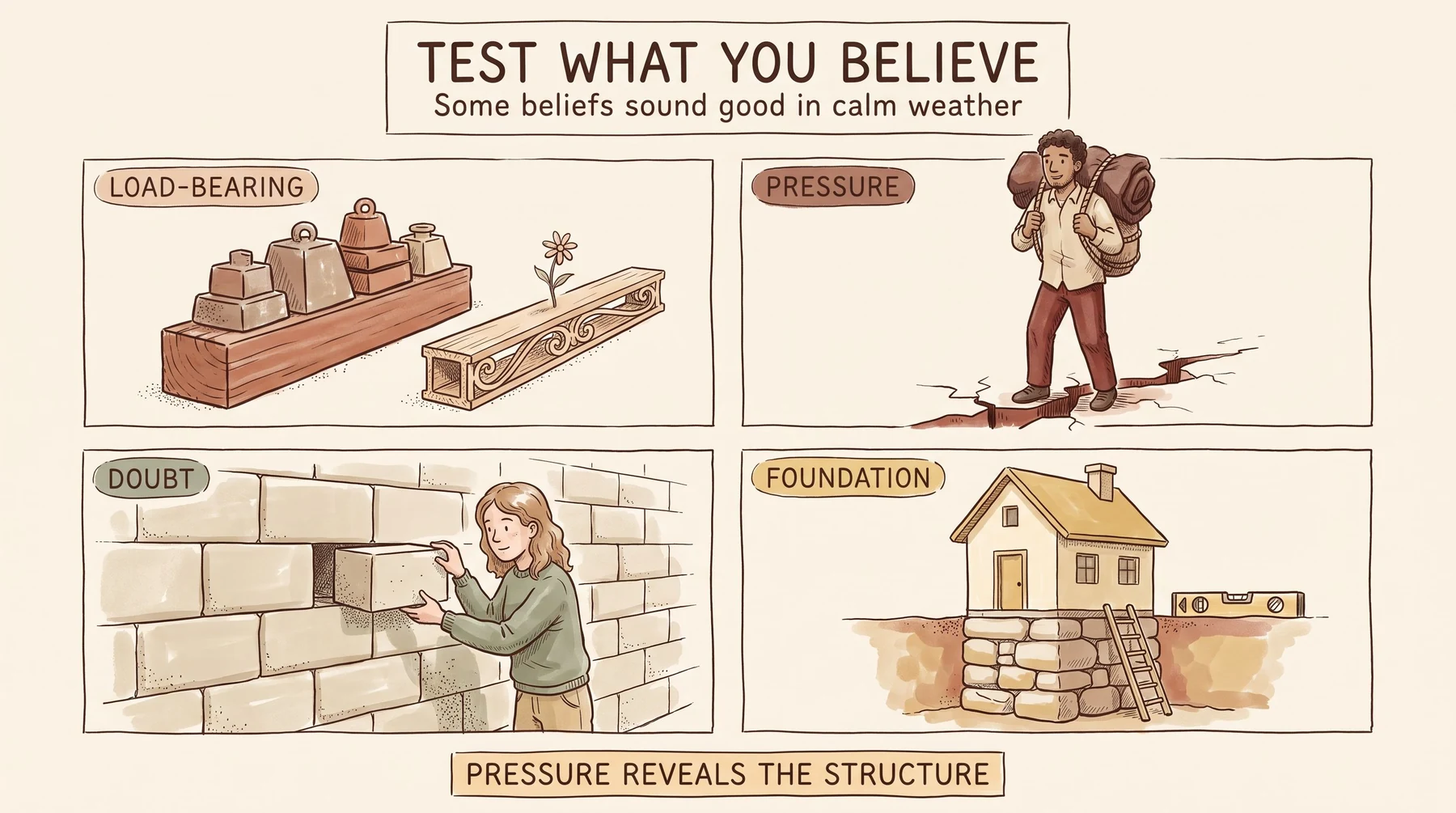
Text version of this graphic
Test what you believe
Some beliefs sound good in calm weather.
Load-bearing. A belief that carries weight still shapes what you do when it costs you something.
Pressure. Suffering, success, hypocrisy and silence all test the structure.
Doubt. Examining a belief honestly is not the same as abandoning it.
Foundation. Build convictions deliberately, on honest ground.
Pressure reveals the structure.
Ask one honest
question.
Choose one practice. You do not need to settle your entire worldview this week.
Name a conviction. Write one value, belief or commitment you want to examine.
Find its source. Family, culture, faith, philosophy, experience, evidence or something else?
Find a challenge. Read or listen to a thoughtful alternative without treating disagreement as an attack.
Test a small action. Let the conviction guide one ordinary choice.
Notice the result. Did the action help, harm, clarify or complicate things?
Talk safely. Discuss the question with someone thoughtful, trustworthy and non-coercive.
Write what changed. Keep the belief, revise it, pause it or identify what you still need to learn.
There is no required final answer. “I do not know yet” can be an honest and responsible conclusion.
Safety and worldview
No person or group should require you to surrender your questions, relationships, money, body, privacy or freedom to prove commitment. If a belief community uses fear, coercion or abuse, seek outside support.
A few questions.
One honest next step.
Choose a question to think about, write about or discuss. In a group, passing is always an option. No belief or doubt needs to be performed for the room.
- Which belief or value has shaped your choices most?
- Where did it come from, and have you examined that source?
- When has a difficult experience changed what you think is true or important?
- What would make your conviction more honest, more useful or more compassionate?
- Who can challenge you without trying to control you?
My conviction or question: …
What I want to examine: …
My safe next conversation or action: …
Before you finish the guide
Use these as reflection prompts, not proof that you have reached a final answer. On this page, ticks are temporary and are not saved.
Essential eight, in short
Convictions become trustworthy when they are examined, lived, tested and held with humility. Keep what proves useful and true, revise what needs revision and leave room for the person you are still becoming.
You can stop reading now. Write one sentence about what you currently believe, what you are unsure about or what you want to live by. Let it be honest rather than impressive.
End of Essential Eight