Essential one / Stillness
The ability
to sit in
silence.
A little less input.
A little more room to think.

For young people of the screen-born generation.
Adapted from Brendan O’Keefe’s onetoeight guide.
V.1.0.0
You only came
to check the time.
An imagined scene. Possibly a familiar one.
It’s 11.47pm. You pick up your phone to set an alarm.
Somehow, you’re now watching a man build a swimming pool in a forest. You have neither a forest nor plans for a swimming pool. Still, you feel you should see how it turns out.
Then there’s a message. A video. A comment so wrong it apparently requires your personal attention.
You put the phone down. In the quiet, tomorrow turns up: the unfinished work, the conversation you’re avoiding, the feeling you haven’t quite named.
You pick the phone up again.
You might recognise that loop. Or your version might involve gaming, podcasts, messages or keeping the television on when you’re not watching it. There’s always something available to fill a gap.
Sometimes that’s useful. Music can make a difficult day bearable. A message can connect you with someone who understands. A ridiculous video can be exactly what you need. Enjoying those things isn’t the problem.
The question is whether you still get a choice. Can you leave a small space unfilled, or does your hand reach for something before you’ve decided?
This essential is about practising that choice. You’re making room to notice what’s happening around you and inside you, before the next thing asks for your attention.
Here, silence means a short break from deliberately adding more input. You can hear traffic, move about or sit near other people. You don’t need an empty house or a mind with nothing in it. You certainly don’t need to become a person who says “my morning ritual” without laughing.
Start with a minute. You can decide what happens after that.
The short version
This chapter is about where your attention goes, and how to get some of it back.
- An endless feed has no final page. Apps make continuing easy, so stopping has to be a choice you make on purpose.
- Willpower alone is a frustrating plan. Change the set-up instead of lecturing yourself.
- A pause is a skill, and one minute is enough to start. Your mind will wander. Returning is part of the practice.
- The aim isn’t using your phone less. It’s being the one who decides.
What you’ll do: one quiet minute a day for a week, and one small change to your surroundings.
Your attention
has plenty of offers.
An endless feed has no final page. Autoplay makes the next decision for you. A notification interrupts whatever you were doing, even when it’s announcing something as urgent as a discount on socks.
These features make continuing easy and stopping something you have to choose. That matters when you’re tired, bored or worried. It helps explain why “I’ll just have more willpower” can be a frustrating plan.
There’s no need to dress this up as a dramatic story about your brain being broken. Dopamine is involved in motivation and learning, among other functions. It isn’t a fuel tank that empties when you put down your phone. Feeling restless in the quiet doesn’t, by itself, mean you’re addicted.
Look at what a habit is doing for you
The same action can serve different needs. You might check a chat because you’re lonely, open a video because you need a laugh, or scroll because starting an assignment feels horrible. Sometimes you’re simply enjoying yourself.
Before changing a habit, get curious about it. “What was I looking for just then?” is more useful than “Why am I like this?”
If you need company, a proper conversation might help more than watching people you don’t know. If you need rest, another half-hour of scrolling may leave you just as tired. If you need help with work, asking someone might get you further than avoiding it.
A small investigation
The next time you reach for your phone without a clear reason, pause. Name what you were doing, what you were feeling and what you hoped the phone would provide. Then choose whether to use it.
You’re allowed to choose yes. The pause still counts.
Connection counts, wherever it happens
A friend on the other side of the country is still a friend. Online communities can offer support you don’t have nearby. This chapter isn’t asking you to give that up.
It asks you to notice the difference between a conversation you value and a feed you keep refreshing despite feeling worse. The useful boundary may be around a particular app, a time of day or a kind of content, rather than every screen in your life.
Your phone does several jobs. You don’t have to sack the entire workforce because one department keeps interrupting.
Your first
quiet minute.
Pick a moment when you’re somewhere safe and don’t need to watch traffic, supervise someone or respond to anything urgent.
Make a little space.
Sit comfortably, stand or move gently in a safe space. Keep your eyes open if you prefer. There is no official sitting position. Your knees have not signed up for anything.
Reduce the interruptions.
Put your phone out of easy reach, if practical. Keep any medical, accessibility, safety or caring functions you need. A timer is optional. If you use your phone, set a gentle timer and leave the screen face down.
Choose something to notice.
Try the contact between your body and the chair, an object in front of you, or a sound nearby. You can notice your breathing if that feels comfortable, but don’t force it to change.
Notice when your mind wanders.
You’ll remember a message, wonder about lunch or start planning next Tuesday. When you notice, gently return your attention to what you chose. You haven’t ruined the minute. Returning is part of the practice.
Finish without giving yourself a grade.
After roughly a minute, look around. Ask, “What did I notice?” One ordinary observation is enough: “I’m tired”, “I kept wanting to check”, or “The fridge is surprisingly loud.”
Keep the useful part
If sitting still is uncomfortable, try slow movement. If silence makes tinnitus or sensory discomfort worse, try gentle background sound. If focusing inside your body is unpleasant, look at something outside it. You can adapt the exercise or leave it.
There’s no need to feel calmer afterwards. You’ve tried a short pause and collected some information. If it was manageable, you can try again another day. If it wasn’t, the next section offers a different way in.
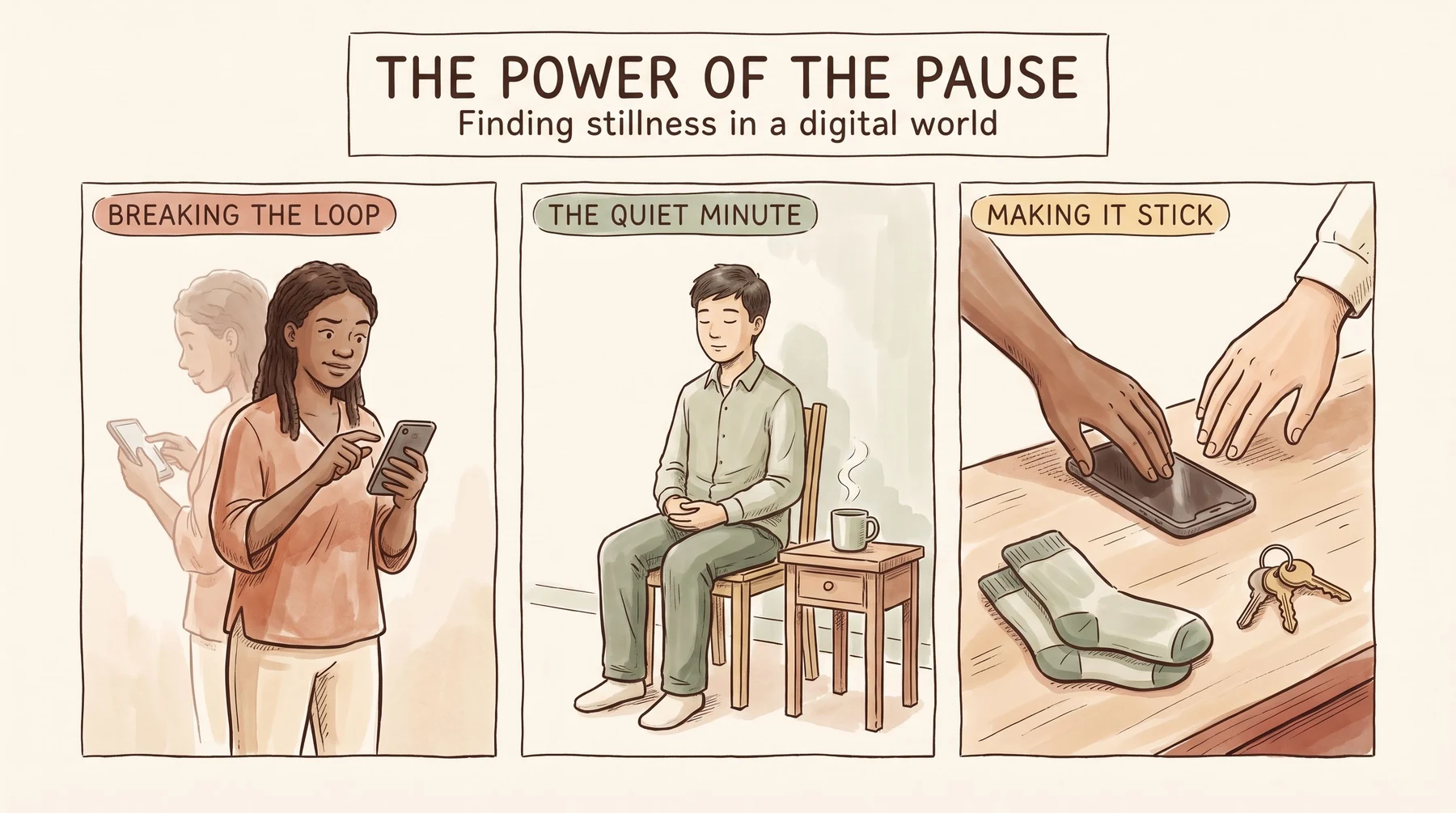
Text version of this graphic
The Power of the Pause: Finding Stillness in a Digital World
1. Breaking the loop. Recognising the automatic reach: we often pick up a phone to check the time and end up scrolling aimlessly. Choice versus autoplay: apps make continuing easy, so stopping has to be a deliberate choice that creates space.
2. The quiet minute practice. Set the scene: reduce interruptions and choose one thing to notice, such as a sound or your breath. Wandering is part of the process: when your mind drifts, gently returning your attention is the core of the practice. Noticing is not solving: use the silence to identify feelings without being pressured to fix them immediately.
3. Making stillness stick. Give your hand an extra decision: move distracting apps off your home screen to interrupt automatic habits. Attach the pause to a routine: practise for one minute after brushing your teeth or before opening a laptop.
A wandering mind
is still a mind.
The first quiet minute might feel restful, boring, irritating or no different from any other minute. You might spend most of it wondering whether it’s finished. There isn’t a fixed sequence you’re supposed to move through.
You don’t have to empty your mind. Thoughts will arrive. Your job is to notice them without treating every one as an instruction.
“I need to reply right now” might be a genuine responsibility. It might also be a habit, or a worry about disappointing someone. A pause gives you a chance to check which.
Noticing isn’t the same as solving
Suppose you realise you’re anxious about tomorrow. You don’t have to fix tomorrow during this minute. Afterwards, you might write down one next step: pack what you need, ask a question or tell someone you’re worried.
Quiet can help you notice a feeling. It doesn’t make every thought accurate. “Everyone thinks I’m an idiot” is a painful thought, not a completed opinion poll. You can question it, talk it through or let it pass without arguing with it for the rest of the evening.
When quiet feels worse
Some people find that turning down outside noise makes difficult thoughts or memories feel louder. If you feel panicky, detached from your surroundings or overwhelmed, stop the exercise. Look around, notice a few familiar objects, move if that helps and contact someone you trust.
You don’t need to prove anything by staying in distress. Try a shorter pause, gentle movement, background sound or being near a supportive person. If it keeps happening, speak with a trusted adult, counsellor, GP or another qualified professional.
A practice, not a treatment plan
This chapter offers an everyday attention exercise. It doesn’t diagnose anything or replace mental healthcare. Research on meditation and mindfulness suggests benefits for some people, but findings vary and some people report adverse effects. That research doesn’t prove that this particular one-minute exercise will help everyone.
A useful outcome can be “I’d rather try this while walking” or “I need support with what came up”. Learning what works for you is more important than reaching a longer time.
Change the set-up.
Spare the lecture.
It’s difficult to practise quiet while a device keeps inviting you elsewhere. Make one small change that helps you pause. You don’t need to redesign your entire life before Thursday.
Decide what deserves to interrupt you
Look at your notifications. Keep the ones that matter for safety, health, access, caring responsibilities and genuinely important contact. Consider switching off promotional alerts, suggested posts and updates you can check later.
A human message isn’t automatically urgent, either. You can care about your friends without responding to every group-chat observation in real time. Let people know when you’re usually available and how to reach you if something matters.
Give your hand an extra decision
Move the app you open automatically off your home screen. Turn off autoplay where you can. Put your phone in a bag rather than beside your hand during one activity. The point is to interrupt a habit long enough to choose, not to make your phone unusable.
If greyscale makes your screen less appealing, you can try it. If it makes things harder to see or use, skip it. A setting is useful only if it helps you.
Attach a pause to something that already happens
After brushing your teeth. Before opening your laptop. Once you’ve come home and put your bag down. Choose a moment that exists in your actual day, rather than the imaginary day in which you wake up early and become a completely different person.
Write a specific plan: “After I put my bag down, I’ll sit by the window for one minute before opening a feed.” If that moment is chaotic, choose another.
Work with the home you have
A busy house, shared bedroom or unpredictable routine may make private quiet difficult. You could try a library, a supervised quiet area at school, or a familiar safe place outdoors. You can also practise with ordinary household sound around you.
If you need your phone nearby for care, access or safety, keep it nearby. If you’re walking, carry what you need, use a safe route and stay aware of your surroundings. Being less distracted should never mean being less safe.
Choose just one change
Which interruption could you reduce without losing something important? Try that change for a few days. Keep it if it helps; adjust it if it doesn’t.
Seven days.
No perfect streak.
Use this as an experiment, not a test of character. Start with a minute or less. Stay at that length all week if it suits you. If it feels comfortable, try two minutes, then perhaps five. Longer isn’t automatically better.
Try the quiet minute. Notice what happens. Change your position, focus or surroundings if you need to.
Repeat at a useful moment. Attach the pause to something you already do. Notice whether that makes it easier to remember.
Notice an automatic reach. Before opening an app, ask what you want from it. Then decide whether to continue.
Remove one interruption. Change a notification or autoplay setting. Keep the functions and contact you need.
Try quiet in company. Spend a brief, comfortable pause beside someone you trust, with their agreement. Or repeat your own practice if you prefer.
Choose an ordinary gap. Try a minute without adding content while waiting somewhere safe. Notice the place you’re in.
Look back. What helped? What irritated you? What would you repeat? Decide on one small practice for next week.
After a pause, you can jot down a sentence or simply remember one observation. Writing by hand is optional. So is recording anything at all.
If you miss a day, continue when you remember. There’s no backlog of silence to complete on Sunday.
Optional stretch
If short pauses are useful, try a ten-minute period without entertainment feeds while you draw, make something or sit outside. Keep necessary technology available. You’re exploring what less input feels like, not entering a digital survival programme.
At the end of the week, “five minutes is too much, but a minute after lunch helps” is a useful result. So is “I prefer a quiet walk”. The aim is a practice you can use, not a number you can boast about.
Take the pause
back into your life.
Practising quiet has a purpose beyond becoming good at sitting quietly. It gives you somewhere to rehearse not responding to every thought, feeling or interruption straight away.
You can try the same pause in ordinary moments.
Before sending the message
You’re annoyed and you’ve written a reply with impressive destructive potential. Leave it unsent for a moment. Read it again. What do you want to happen after the other person sees it?
You might still need to say something firm. A pause gives you a chance to choose words that say what you mean without creating a second problem.
When someone is talking
A friend tells you something difficult. You don’t have to fill the first gap with advice or a story about when something similar happened to you.
Give them time. You could ask, “Do you want me to listen, or help you think about what to do?” Being present can involve words as well as quiet. It doesn’t mean keeping serious worries secret or trying to handle a crisis alone.
When a decision feels crowded
Subject choices, friendships, study, work and relationships can attract plenty of opinions. Before collecting more, take a moment to name what matters to you and what information you’re missing.
Your first feeling isn’t necessarily the right answer. Quiet doesn’t replace evidence or good advice. It can help you arrive at a conversation with a clearer question.
When you need a break
Not every pause needs to produce an insight. You can look out of a window without converting the experience into personal development. Sometimes you’ll notice a bird. Sometimes you’ll notice that the window needs cleaning. Both are allowed.
People use quiet in different ways, including reflection, meditation and religious practice. You can bring your own beliefs to it, or none. This chapter asks for no particular worldview and promises no special revelation.
That might mean putting the phone down. It might mean using it to call someone, look something up or ask for help. What matters is that you’ve noticed what you need and made a choice.
A few questions.
One next step.
Choose a question to think about, write about or discuss. In a group, passing is always an option. Nobody owes the room a personal disclosure.
- When does your phone help you feel connected? When does it leave you feeling further away?
- What did you notice in a quiet minute that you hadn’t noticed beforehand?
- What makes a pause difficult for you: your surroundings, your responsibilities, your thoughts or something else?
- Which feels more useful right now: less input, more support from someone, or both?
- Where could a small pause help you make a choice this week?
My moment: After I…
My practice: I’ll pause for… and notice…
My adjustment: If that doesn’t suit me, I’ll try…
Before you move on
Use these as reflection prompts, not entry requirements for the next essential. On this page, ticks are temporary and are not saved.
Essential one, in short
A quiet pause gives you a chance to notice what’s happening before adding more input. Start small, adapt it to your life and don’t force yourself through distress. The useful skill is noticing and choosing, not sitting perfectly still.
You can stop reading now. If it’s a suitable moment, look away from this page and notice something in the room. Stay there for a little while. Then decide what you want to do next.
End of Essential One