Essential five / Belonging
Build
real
community.
Be known.
Show up. Make room.

For young people of the screen-born generation.
Adapted from Brendan O’Keefe’s onetoeight guide.
V.1.0.0
Being seen
is not being known.
An imagined scene. The details may vary.
You post something difficult. People respond with hearts, kind comments and a few messages saying, “Here if you need anything.”
You are grateful. You are also sitting alone at 2am, unsure who you could actually call.
Another version looks less dramatic. You have plenty of group chats but no one you want to ask for help. You know people at school, work, sport or university, but most conversations stop at “How are you?” followed by “Good, you?”
There is nothing wrong with having followers, acquaintances or online friends. They can be enjoyable and meaningful. The question is whether you also have relationships with enough trust, time and mutual care to hold something real.
Community is not a popularity score. It is the network of people with whom you can share attention, responsibility, humour, practical help or honest conversation.
It can happen online, in person or across both. A friend who lives far away may know you better than someone who lives next door. A group chat can become a real source of care. A local club can still feel lonely if nobody makes room for you.
This essential is about building relationships deliberately, while keeping sensible boundaries. You do not need dozens of close friends. You do not need to be available at 2am. You do need some way to give and receive support, and some places where you are more than a profile.
The short version
This chapter is about building relationships that hold, rather than collecting an audience.
- Being seen is not being known. Hearts and kind comments are not the same as someone you could call at two in the morning.
- Belonging is built in small repetitions: showing up, paying attention, give and take, and safety.
- Digital connection can be real. A friend on the other side of the country is still a friend.
- More people is not always the answer. Better fit and clearer support can matter more.
What you’ll do: one small act of connection a day for a week, and one clear thing you ask someone for.
Belonging is built
in small repetitions.
Presence
People become familiar through repeated contact. The same class, shift, rehearsal, team, volunteer session, gaming group or shared meal can become a place where relationships grow. You do not have to be fascinating every time. Showing up while being ordinary is surprisingly powerful.
Attention
Ask a real follow-up question. Remember the exam, appointment, family member or project someone mentioned. Put your phone down for part of a conversation. Attention says, “You are not just background noise in my day.”
Reciprocity
Healthy friendship has movement in both directions. One person may need more support during a difficult season, but a relationship that always takes from one person is not a community. Notice whether you can ask, offer, say no and repair misunderstandings.
Safety
Being known does not mean telling everyone everything. Trust should grow at a pace that feels safe. You can keep private information private, leave a group, block someone or ask for adult and professional help when a relationship becomes controlling, threatening or exploitative.
Not every lonely feeling needs a bigger social life
You may need rest, therapy, practical support, a smaller group or a different kind of connection. “More people” is not always the answer. Better fit and clearer support can matter more.
Community is not a performance in which you prove that you are lovable by being endlessly helpful. It is a place where people can contribute and still have limits.
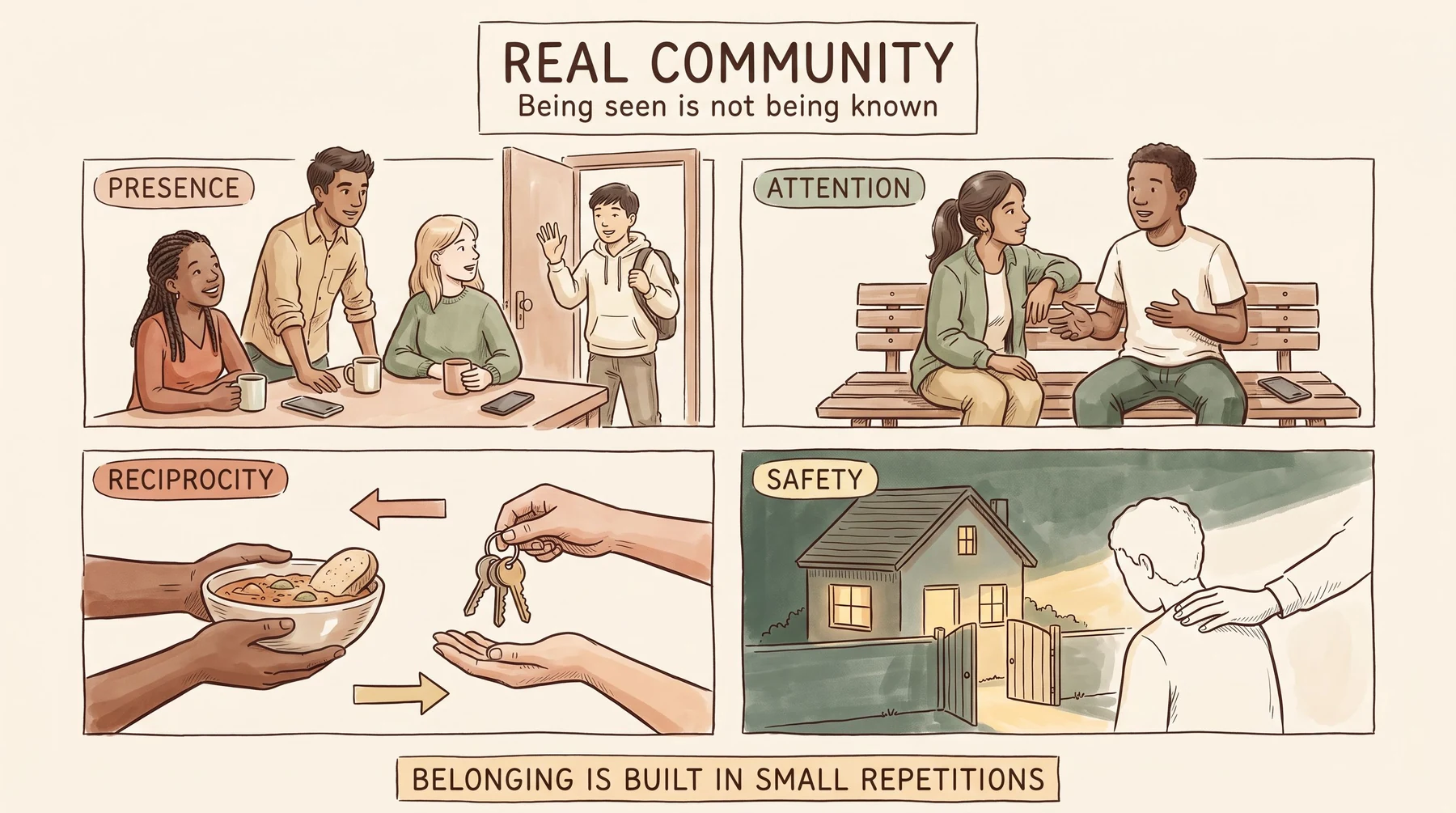
Text version of this graphic
Real community
Being seen is not being known.
Presence. Turn up in person, with the phone out of the way.
Attention. Listening is the thing that makes someone feel known.
Reciprocity. Give and receive both ways: food, keys, lifts, help.
Safety. Trust that holds, and dependable cover when things go wrong.
Belonging is built in small repetitions.
Make a map,
not a ranking.
Different people can support different parts of your life. One person does not need to be your entire emergency system.
Everyday people.
Who do you enjoy seeing regularly? These relationships may be light, but they can become deeper through time and attention.
Honest people.
Who could hear that you are struggling without turning it into gossip, a competition or a lecture?
Practical people.
Who knows how to help with transport, study, work, health, money, technology or a specific skill?
Professional support.
Which services, counsellors, teachers, doctors, youth workers or helplines belong on your wider support map?
Write names only if it is safe to do so. You can also write roles: “my tutor”, “the GP”, “the club leader”, “a trusted adult”.
Now ask a kinder version of the 2am question: who could I contact if something serious happened, and what would be the safest route? A crisis is not a test of friendship, and the right response may be emergency or professional support rather than a mate driving across town.
Your boundaries count
Being dependable does not mean being permanently available. You can say, “I care about you, but I cannot handle this alone. Let’s contact someone who can help.” That is community, too.
Community needs
something to stand on.
Show up
Choose one place where you can return regularly. Arrive early enough to notice who is there. Learn names. Consistency gives people a chance to trust that you are not just passing through.
Initiate
Invite someone for a walk, meal, study session, game or coffee. Be specific about the time and plan. Most people are not rejecting you; they are waiting for a practical invitation that does not require them to solve the entire afternoon.
Be honest in proportion
Share something real, but do not turn the first conversation into an autobiography. Notice whether the other person responds with care. Trust is built through repeated evidence, not one dramatic disclosure.
Repair
Community includes misunderstandings. Ask what happened. Apologise for your part. Say what you need next time. Repair does not mean accepting repeated harm or staying in an unsafe relationship.
Make room
Look for the person standing at the edge of the group, while remembering that not everyone wants to be pulled into the centre. Offer a low-pressure invitation. Let them choose.
A practical invitation
“I’m making dinner on Thursday. No pressure, but you’re welcome to come at seven. We can eat, play something or leave early.” Clear, kind and not mysteriously shaped like a networking event.
You do not need to build community by becoming the organiser of everything. Share the work. Let other people initiate too.
Digital connection
can be real.
Online relationships are not automatically shallow. People find friendship, identity, creative collaboration, mutual aid and vital support online, especially when local options are limited. A screen does not decide whether a relationship matters.
What matters is the quality of the relationship and the conditions around it. Can you be honest? Is there reciprocity? Do you feel safer, steadier and more yourself, or increasingly controlled and anxious?
Keep your options wider than one platform
If every relationship depends on one app, a ban, account loss or algorithm change can cut off your support. Where appropriate, exchange another safe contact method. Keep your own boundaries around location, images, money and personal information.
Do not confuse access with obligation
A friend may be online without being available. You may need a break without explaining every detail. Notifications are not summonses. Ask before calling, respect a no and avoid using guilt as proof of closeness.
Meet carefully when meeting in person
If you meet an online friend offline, choose a public place, tell someone you trust, arrange your own way home and keep control of your phone and money. Young people should involve a trusted adult when appropriate. If the person objects to basic safety, that is useful information.
A community can have edges
Good groups do not require you to abandon every other relationship, hide contact from trusted people or prove loyalty through secrecy. Belonging should expand your life, not quietly close it down.
One small act
of connection.
Choose one action that feels possible. Do not use this list to force intimacy with someone who has not earned your trust.
Send a specific invitation. Suggest a time and activity to someone you would like to know better.
Follow up. Ask about something someone told you last week and listen to the answer.
Return somewhere. Attend the same club, group, class, server or community space again.
Offer practical help. Do one useful thing without taking over or expecting a reward.
Ask clearly. Tell a trusted person one small way they could support you.
Include gently. Offer someone on the edge a low-pressure invitation and respect their answer.
Review the fit. Which connection left you more yourself? Which boundary needs strengthening?
Community is not measured by whether everyone likes you. A useful week may involve one good conversation, one boundary or the realisation that you need professional support.
If you feel isolated
Tell someone directly: “I’ve been feeling alone and I want help finding people.” A GP, counsellor, youth worker, school or university support service can help you find options. If you are in immediate danger, contact emergency services.
You can give weight
without carrying all of it.
Real community includes practical help: cooking, listening, driving, checking in, sharing information, sitting quietly and making space. It also includes receiving. If you only give, people may never know how to care for you. If you only receive, the relationship may become unbalanced.
Support is not a transaction in which every kindness must be repaid immediately. It is a pattern over time. During one season you may need more. During another, you may have more to offer.
Ask before helping
“Do you want listening, ideas or practical help?” is a useful question. Do not arrive with a rescue plan when someone needs company. Do not promise secrecy if someone is at risk. Do not make another person’s crisis your private responsibility.
Community and difference
People do not need identical beliefs, ages, backgrounds or interests to care for one another. They do need respect. A mixed community asks who is missing, who has less power and what would make participation safer.
Faith communities, sports clubs, music groups, workplaces, neighbourhoods, online communities, mutual-aid projects and friendship circles can all become places of belonging. None does so automatically. People make the culture by what they tolerate and practise.
The aim is not a perfect group. It is a more human one: honest enough for difficulty, flexible enough for difference and dependable enough that people do not have to perform being fine.
A few questions.
One act of care.
Choose a question to think about, write about or discuss. In a group, passing is always an option. Do not share another person’s private story without consent.
- Where do you feel most able to be yourself, online or offline?
- Who could you contact if you needed emotional, practical or professional support?
- What makes it easier or harder for you to initiate a friendship?
- Where might you need a stronger boundary rather than a larger social circle?
- Who is on the edge of a group you belong to, and what low-pressure invitation could you offer?
Someone I want to contact: …
One invitation or check-in: …
A boundary I need: …
Before you move on
Use these as reflection prompts, not entry requirements for the next essential. On this page, ticks are temporary and are not saved.
Essential five, in short
Community grows through repeated presence, attention, reciprocity, safety and repair. Build relationships where people can be known without being trapped, supported without being rescued and included without being managed.
You can stop reading now. Think of one person, group or support service that belongs in your wider map. Decide whether the next step is a message, an invitation, a boundary or a request for help.
End of Essential Five