Essential seven / Attention
Make room
for the
outside.
Look up.
Go gently. Notice more.
For young people of the screen-born generation.
Adapted from Brendan O’Keefe’s onetoeight guide.
V.1.0.0
You can spend
a whole day inside.
An imagined scene. The details may vary.
You move from bed to desk, desk to kitchen, kitchen to sofa. There is daylight somewhere behind the curtains, but you meet it only as a brightness on the wall.
You have travelled through several apps, watched three people renovate rooms and answered messages from people in five cities. You have been connected all day.
Still, your shoulders are tight. Your thoughts are noisy. You cannot remember the last time you felt the weather rather than checked it.
A friend suggests a short walk. You say you are too busy, then spend twenty minutes deciding what to watch.
Nature is not a personality type. You do not need hiking boots, a tent or a strong opinion about moss. A street tree, balcony, garden, park, beach, river path or patch of sky can be a place to begin.
Time outdoors may support mood, attention, sleep and a sense of connection. It is not a cure for depression, anxiety, illness or difficult circumstances. It is one possible support, not a replacement for care.
This essential is about making regular contact with the non-digital world. Go outside safely. Notice what is there. Let your attention rest on something that is not asking you to click.
The short version
This chapter is about getting outside regularly, without turning it into another performance.
- You can spend a whole day inside and still feel you have been everywhere.
- Attention changes when the world is not performing. Outside, nothing is engineered to keep you scrolling.
- Small and regular beats heroic and rare. Ten minutes counts.
- Nature is not equally available to everyone. Work with the barriers rather than blaming yourself.
What you’ll do: notice one thing outside each day for a week, and find one rhythm that fits your actual life.
Attention changes
when the world is not performing.
Natural places often contain movement, sound, texture and change without demanding a response. Leaves move. Light shifts. Birds interrupt one another. Clouds do not need you to share them.
This kind of gentle attention can feel different from concentrating on a task or reacting to a feed. You can notice without producing anything.
Light and daily rhythm
Natural daylight helps your body distinguish day from night. Getting outside during the day can support a regular rhythm, though it will not solve every sleep problem. If you are sensitive to light, work nights, have migraines or have another health condition, adapt the timing and intensity.
Protect your skin and eyes. Do not stare at the sun. Follow local sun-safety guidance, use shade and sunscreen where appropriate, and remember that cloudy weather can still involve UV exposure.
Movement without performance
A walk can be exercise, transport, social time or simply a change of scene. You do not need to track distance, calories or pace unless those measures genuinely help you. Move in ways your body can access and stop if something hurts or feels unsafe.
Nature is not a treatment vending machine
You may feel calmer after a walk. You may feel exactly as stressed as before, but outdoors. Both are possible. Keep the practice because it supports your life, not because you have failed if it does not produce instant transformation.
Access matters. Some people face unsafe streets, pollution, extreme weather, mobility barriers, sensory overload, discrimination or no nearby green space. Indoor plants, a window, a garden centre, a quiet courtyard or nature recordings can be useful adaptations, not inferior substitutes.
Try ten minutes
of noticing.
Choose a safe place and a time when you do not need to rush. Keep your phone for safety, access and navigation. You can put it away without pretending it has never been invented.
Arrive.
Notice the temperature, light, ground and sounds. You do not have to name everything.
Look near and far.
Find one detail close to you and one thing in the distance. Let your eyes move slowly between them.
Listen.
Notice the loudest sound, the quietest sound and any sound that changes. Traffic counts. Nature does not require silence.
Stay curious.
What is growing, moving, weathering or being used by another creature? You can wonder without needing to look up the answer.
Make it accessible
Sit by a window, use a wheelchair-friendly route, go with someone, wear headphones, choose a less busy time or stay near home. If outdoors is unsafe or overwhelming today, choose a gentler version.
At the end, ask only: “What did I notice?” You do not need a mood score. A single detail is enough.
Small and regular
beats heroic and rare.
The daily contact
Try a few minutes outside at a point your day can actually support: after waking, between classes, at lunch, after work or before dinner. A short sit by an open window may be the version you can repeat.
The weekly wander
Once a week, choose a longer visit to a park, beach, trail, garden, river, woodland or other accessible place. Go alone if that feels safe, or invite someone. You can walk, sit, sketch, photograph, talk or do absolutely nothing impressive.
The seasonal eye
Notice what changes where you live. Which plants appear? When does the light shift? What sounds arrive or disappear? A small record in a notebook can turn “nature” from an idea into a relationship with a particular place.
Grow or care for something
A windowsill herb, houseplant, community garden or borrowed patch of soil can create a small responsibility to the living world. If plants do not work for your space or health, notice and care for another part of your environment.
Choose the place. Nearby, safe and accessible is more useful than spectacular.
Choose the cue. Attach the pause to an existing part of your day.
Choose the company. Alone, with a friend, with a group or with support.
The best nature routine is the one that survives rain, deadlines, low energy and the occasional desire to remain horizontal.
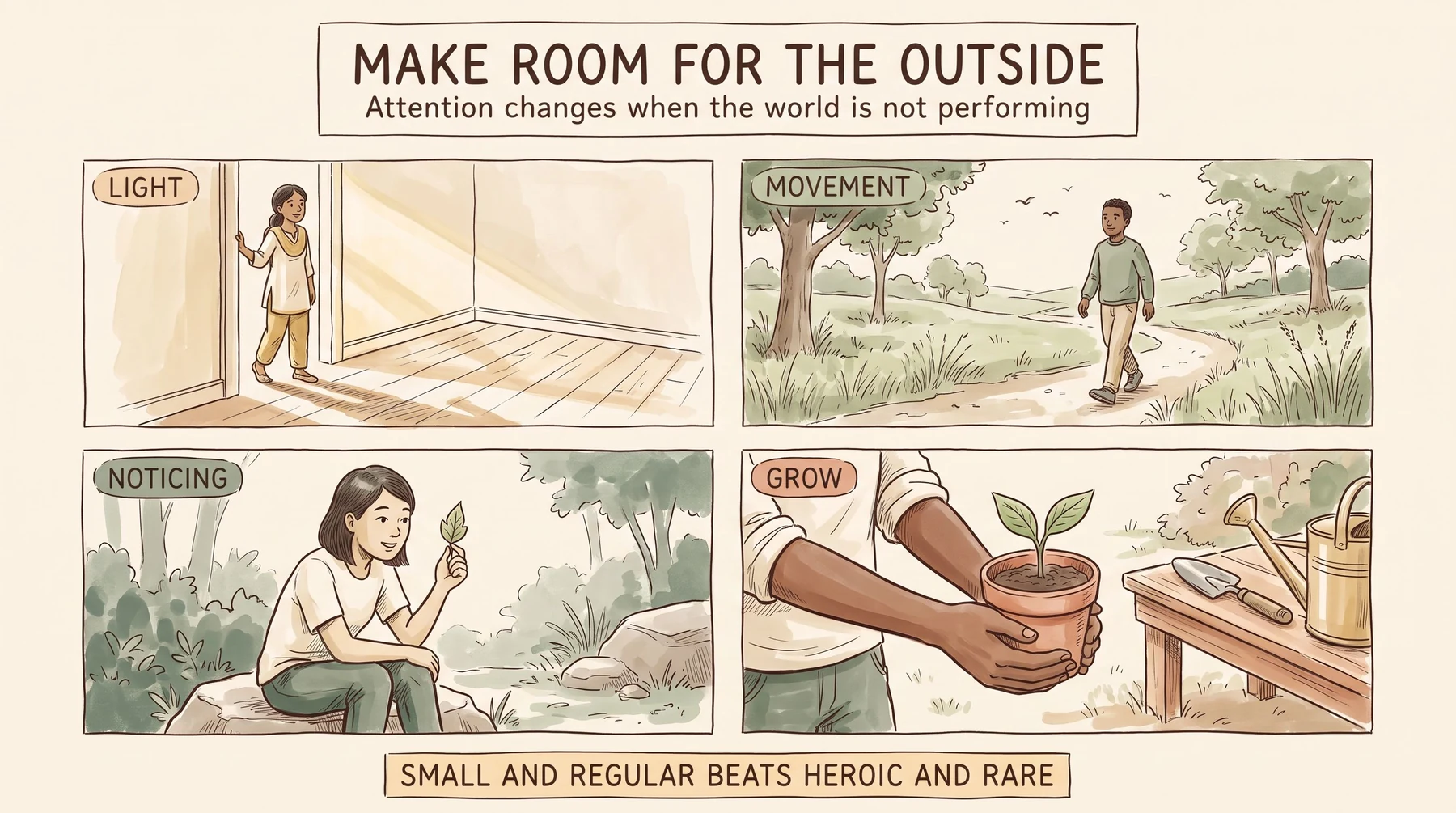
Text version of this graphic
Make room for the outside
Attention changes when the world is not performing.
Light. Get outside light early in the day, and let your daily rhythm follow it.
Movement. Walking counts. It does not need to be training or a performance.
Noticing. Ten minutes outside, looking near and far, listening and staying curious.
Grow. Care for something living, even one pot on a windowsill.
Small and regular beats heroic and rare.
Nature is not equally
available to everyone.
A chapter can make “just go outside” sound simple. It may not be. You may live far from green space, share a crowded home, lack transport, have caring responsibilities, face unsafe public spaces or have a body and nervous system that need careful planning.
Start with the barrier rather than blaming yourself.
No time
Try five minutes near a usual destination, a lunch break outside, or a window while you drink something. You do not need a two-hour expedition for contact to count.
No safe or accessible route
Go with someone, choose a familiar route, use a courtyard or community space, ask about accessible facilities or use a balcony and window. A local service or support worker may know options you have not been told about.
Sensory or health barriers
Choose quieter times, predictable paths, shade, layers, ear defenders, mobility aids, medication plans or shorter visits. If outdoor exposure affects your health, ask a qualified professional for advice.
Weather and pollution
Check conditions. Avoid dangerous heat, storms, poor air quality and unsafe water. Outdoor time is not a bravery test. An indoor adaptation is wiser than a risky outing.
A realistic prescription
Write: “I will spend ten minutes in or near nature, at this place, after this event, using this adaptation.” Specific and kind beats heroic and vague.
Notice one thing
each day.
Use the version that fits your life. Keep safety, access and weather in the plan.
Look at the sky. Notice light, cloud or weather without opening an app first.
Take a short outside pause. Stand, sit or roll somewhere safe for five to ten minutes.
Walk a familiar route differently. Notice one tree, building, sound or patch of ground.
Share the outside. Invite someone for a walk or sit together outdoors.
Care for a living thing. Water, plant, observe or learn about something nearby.
Take a longer visit. Spend as long as is safe and comfortable in a natural setting.
Review honestly. What helped? What barrier needs a better adaptation?
Track how you feel if that is useful, but do not turn nature into another dashboard. You are allowed to go outside without optimising the experience.
Phone rules
Keep your phone if you need it for safety, access, navigation or emergencies. You can silence entertainment notifications and still remain reachable to the people who matter.
The outside links
the other essentials.
Nature can offer a setting for silence, a reason to move, a place to talk, a source of knowledge and a reminder that your attention belongs to more than a feed.
Walking beside someone can make conversation easier. Learning a local tree or bird can turn a familiar route into a source of knowledge. Growing food connects capability with care. A quiet sky can give a difficult question more space.
None of this needs a religious interpretation. Some people experience nature as spiritual. Others experience beauty, science, interdependence, memory or simple relief from fluorescent lighting. The meaning can remain yours.
Practise attention without possession
You do not need to photograph every sunset. You do not need to identify every plant or turn a walk into content. Let some experiences remain unposted. Notice the world without asking what it can give your profile.
Nature is not an escape from every problem. It is one place where you can meet the world directly, with a little less mediation. That can be enough for ten minutes.
A few questions.
One outside moment.
Choose a question to think about, write about or discuss. In a group, passing is always an option. You do not need to disclose health or access information.
- Where can you safely and realistically spend a few minutes outside or near nature?
- What barriers make outdoor time difficult for you?
- Which adaptation would make a nature pause more comfortable or accessible?
- What do you notice outdoors that you rarely notice on a screen?
- Who could you invite to share an outside moment without making it a performance?
My place: …
My cue and adaptation: …
One thing I will notice: …
Before you move on
Use these as reflection prompts, not entry requirements for the next essential. On this page, ticks are temporary and are not saved.
Essential seven, in short
Nature is not a luxury or a personality. Regular contact with the outside can support attention, movement, rhythm and connection. Start nearby, adapt it to your life and notice without needing to optimise.
You can stop reading now. Look towards a window, doorway or patch of sky. Notice one thing that is changing, growing, moving or simply there.
End of Essential Seven