Essential six / Learning
Knowledge
you can
carry.
Remember more.
Own the useful bits.

For young people of the screen-born generation.
Adapted from Brendan O’Keefe’s onetoeight guide.
V.1.0.0
You know how
to find it.
An imagined scene. The details may vary.
Your phone dies while you are out. You need an address, a phone number and a route home.
You know the information exists. You just do not have it with you.
Or you are revising and remember seeing the answer somewhere. You search, scan the first result and move on. The next day, the answer has evaporated. The search worked. Learning did not quite get invited.
There is nothing wrong with looking things up. Nobody should memorise every bus timetable, tax threshold or obscure fact about penguins.
The useful distinction is between knowing something and knowing how to find something. External tools make life easier. Internal knowledge gives you a starting point when the tool is unavailable, unreliable or trying to sell you something.
Knowledge Without Wi-Fi is not an instruction to reject the internet. It is an invitation to build a base of understanding, memory, judgement and practical reference material that travels with you.
You are not stupid because you check. You become more capable when you can check, understand, remember what matters and judge whether the answer deserves your trust.
The short version
This chapter is about owning what you know, rather than renting it from a search bar.
- Search gives you a result. Learning gives you a framework.
- Own the things you would miss most: people, places, practical references and the files that matter.
- Memory likes being invited back. Looking something up once is not the same as carrying it.
- Make room for the difficult bit. That is where the learning actually happens.
What you’ll do: carry one useful thing further over a week, and keep one offline copy where you can find it.
Search gives you
a result. Learning gives you a framework.
Information is a fact, instruction or piece of data. Knowledge is information you understand well enough to recognise, explain or use. Wisdom adds judgement about when and why to use it.
Search results are not automatically true. A confident page can be wrong, outdated, biased or written to sell you something. A strong knowledge base gives you questions to ask: Who says this? What evidence supports it? What would change my mind? Does it fit what I already know?
Practise retrieval, not just recognition
When you reread a page, it can feel familiar without being available from memory. Close the notes and explain the idea in your own words. Try a problem without looking at the worked answer. Draw the route. Write the steps. Then check what you missed.
Let tools assist rather than replace
A calculator is useful. A map is useful. An AI assistant can help you explore a topic. Use the tool, then ask what you understand without it. If a tool gives you an answer, inspect it before repeating it.
A better offline test
Put the screen away for ten minutes and explain one thing you have recently learned to an imaginary person who is interested but not impressed. If you cannot explain it yet, you have found the next bit to learn.
Learning is allowed to be slow. Struggle is not proof that you are bad at a subject. It is often the point where your brain is building a route.
Own the things
you would miss most.
Resilience does not require a bunker full of encyclopaedias. It requires a sensible layer of knowledge and materials you can access when the usual system is unavailable.
People and places.
Know your address, important contacts and a safe route to places you use. Keep essential information somewhere secure as well as in your phone.
Practical references.
A cookbook, first-aid guide, repair manual, local map or course notes can be useful offline. Choose current, reputable material for safety-critical subjects.
Personal meaning.
Keep poems, songs, stories, ideas or cultural knowledge that help you think and remember who you are. Ownership is not limited to facts.
Offline digital copies.
Download maps, tickets, documents or reference material when you are allowed to. Back up important files and test that they open.
Paper is useful, but paper is not automatically superior. A phone with accessible offline information may work better than a book for some people. The principle is control and access, not nostalgia.
Local tools are still tools
Offline software and local AI can reduce dependence on a connection, but they still need hardware, power, storage, updates and careful source checking. “Local” does not mean “always correct”.
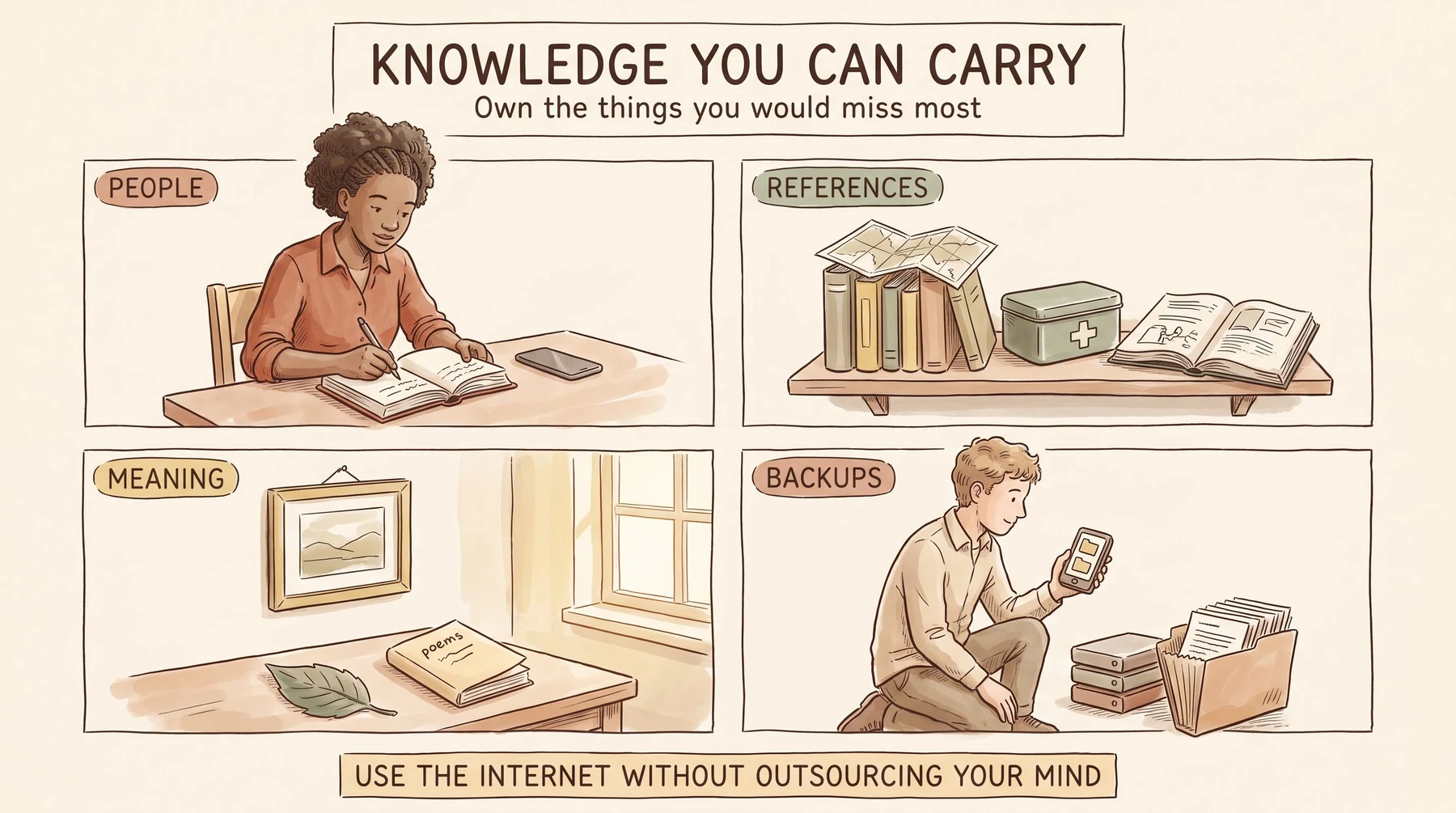
Text version of this graphic
Knowledge you can carry
Own the things you would miss most.
People. Keep the contacts, addresses and routes you would need if your phone was gone.
References. A few practical books, a map, a first-aid guide, a repair manual.
Meaning. Poems, songs, stories and images worth keeping for who they are.
Backups. Offline copies of the documents and files that matter.
Use the internet without outsourcing your mind.
Memory likes
being invited back.
Memory improves when you retrieve information repeatedly, space practice over time and connect new ideas to things you already understand. Reading something once and hoping your brain files it correctly is a charming plan, but not a reliable one.
Try a simple loop
Choose a small piece.
A phone number, paragraph, route, formula, recipe step, poem or key idea. Smaller is more repeatable.
Look, hide, retrieve.
Read it, cover it and say or write what you remember. Check the original and correct yourself.
Space it out.
Try again later that day, the next day and a few days after. Short returns beat one heroic cram session.
Make it meaningful
Memorising a passage you care about is different from memorising random trivia. So is learning a recipe your family uses, the names of local plants, first aid, a piece of music or the route to a friend’s home.
Do not memorise safety-critical instructions from an old page and assume they are current. Check official guidance when the details matter. Memory should support judgement, not replace it.
Your brain is not a cupboard
You do not need to fill it with everything. Choose what deserves space. The point is not to win a pub quiz. It is to carry useful understanding into the moments when searching is slow, impossible or distracting.
Make room for
the difficult bit.
Deep learning needs attention. Put the phone away for a short, realistic period. Work on one question. When you get stuck, name exactly where you are stuck instead of deciding that your entire brain has resigned.
Use an active method
Explain the concept aloud. Draw it. Compare two examples. Teach it to someone. Attempt a problem before viewing the answer. Write down what you thought would happen and what actually happened.
Keep a question list
When something is confusing, write the question in plain language. “I do not understand photosynthesis” is too large. “Why does the plant need light after it has water?” gives you somewhere to begin.
Check the source
For health, law, money, safety and current events, use more than one reliable source and check the date. An attractive infographic may be wrong. An AI answer may be fluent and wrong. Confidence is not evidence.
Read. Take in a manageable piece of information.
Recall. Close it and explain what you remember.
Apply. Use it in a problem, example or real task.
Check. Compare your understanding with a trustworthy source.
Learning is not a competition between your memory and the internet. It is a partnership in which you remain the person making sense of things.
Carry one useful
thing further.
Choose one piece of knowledge and move it from “I can find that” towards “I understand and can use that”.
Choose the knowledge. Pick a route, recipe, passage, formula, skill or question you genuinely value.
Find a good source. Use a book, teacher, official guide, trusted person or reliable course.
Write it by hand. Make a short summary or set of steps in your own words.
Put the source away. Try to retrieve or explain the idea without looking.
Use it. Cook, calculate, navigate, teach, make or solve something with it.
Correct it. Check where your memory or understanding was incomplete.
Store the backup. Keep a useful paper or offline copy where you can find it later.
One useful idea carried well is better than a hundred saved links you will never open again.
An offline afternoon
Try an hour without search, streaming or social feeds. Read, cook, draw, walk with a paper map, write, talk or repair something. Notice what you can do already and what you want to learn.
Knowledge should
change how you live.
Information becomes useful when it helps you decide, create, care, question or act. A first-aid fact you remember can help someone. A map can get you home. A poem can give language to grief. A budgeting idea can give you a choice. A recipe can feed people.
Knowledge without humility becomes a performance. You will be wrong about things. Everyone is. The aim is not to become the person who corrects everyone at dinner. It is to remain curious enough to update your understanding.
Learn from people, not only pages
Ask a grandparent how they repaired something. Ask a neighbour about local history. Ask a tradesperson why they chose a particular method. Ask a friend to show you a skill. Lived knowledge often contains details that a search result misses.
Keep a personal reference shelf
Your shelf may be physical, digital, audio, tactile or shared. Keep the materials that help you live your actual life: study references, recipes, maps, accessibility guides, creative work, repair instructions and texts that shape your values.
The internet can remain vast and useful. Let it extend your foundation, not replace it. If the connection disappears for an afternoon, you should lose convenience, not your entire ability to think.
A few questions.
One thing to carry.
Choose a question to think about, write about or discuss. In a group, passing is always an option. You do not need to prove your intelligence.
- What do you know well enough to explain without a search?
- Which piece of knowledge would be useful if your phone or internet stopped working for a day?
- Where do you tend to accept the first answer you find? What would a better check look like?
- What would you like to memorise, practise or understand more deeply?
- Which person in your life carries knowledge you would like to learn?
Knowledge I want to own: …
My source and practice: …
Where I will keep the backup: …
Before you move on
Use these as reflection prompts, not entry requirements for the next essential. On this page, ticks are temporary and are not saved.
Essential six, in short
Use the internet as a tool, not a substitute for understanding. Practise recalling, applying and checking what matters. Carry useful knowledge in your head, hands, relationships and offline resources.
You can stop reading now. Choose one thing you normally search for and see what you remember. Then decide whether it deserves a place in your portable knowledge base.
End of Essential Six